Free AI API: The Fine Print Nobody Reads (and What to Do Instead)
Search results for free AI API follow a script: a tier labeled Free, a button that says Get Started, and a rate card you never read. The tier is real, but its fine print is the product — rate limits that break a demo in production, credits that expire before the weekend, data terms you would rather not learn about later, and prices that change with a notice period nobody checks. The “free” search should not end at the sign-up button. It should end at a plain-English reading of the terms, and GPT-5.6 Luna is a useful baseline to compare what models actually cost against the real alternative: paying the vendor’s list price with no markup on top.
Every developer has lived this. A demo that hummed along at sixty requests a minute on Tuesday is throttle to three on Wednesday. The account that was free to sign up stops accepting new users a month after you migrated your tooling to it. The free tier was real the fine print was just in the emails you archive. Free AI APIs are genuinely useful for evaluation and prototyping, but they are trials wearing the label “free,” and the terms, not the button, decide what the tier actually costs.
The five clauses that decide what “free” costs
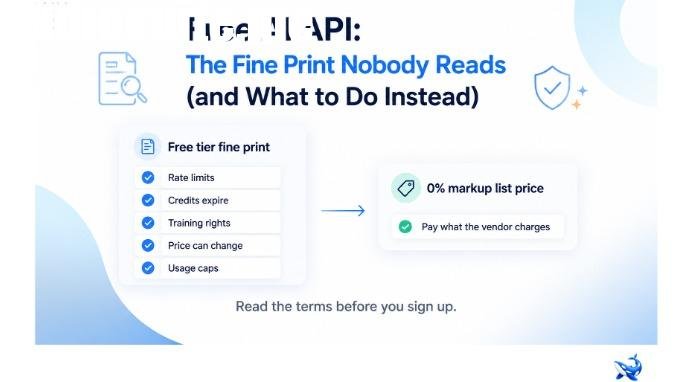
Free tiers all work the same way: a limited budget, a deadline, and a set of conditions. Five clauses account for nearly every surprise, and each one shows up differently depending on the provider.
| Clause | What it usually says | What it means for you |
| Rate limits | Requests per minute, tokens per day | A prototype passes, a beta fails |
| Credit expiry | Trial credits valid for a set period | Your “free” budget has a deadline |
| Data and training terms | Inputs may be used to improve services | Your prompts become training material |
| Price-change clauses | Rates can change on notice | Free can stop being free |
| Usage caps | Account-level daily or monthly ceilings | Throttling that reads as downtime |
Rate limits are the most visible and the most misread. The number that reads fine for a demo is the number that breaks a beta. Look for the per-minute request cap and the per-day token cap, then ask what happens at the limit: polite throttling, or a hard stop that fails the request.
Credit expiry is the clause nobody quotes in the blog post. “Free” often means “a credit balance with an expiration date,” and trial credits are a deadline in disguise. If the expiry is measured in days, the tier is a demo environment, not infrastructure.
Data and training terms are the clause that should scare you the most. Check whether your prompts can be use to improve the provider’s models, and whether that changes when you start paying. For anything holding customer data, this one clause decides whether the tier is usable at all.
Price-change clauses are the quiet one. The terms usually reserve the right to change rates with notice, and “free” is not a contract — it is a temporary state of a price page. A free tier can become a paid tier, or a paid tier can jump in price, on the notice period in the terms you accepted.
Usage caps round out the set: account-level ceilings that show up as downtime. The tier you chose for cost reasons quietly becomes the reason your service has gaps at the worst possible moment.
How to read the terms in five minutes
You do not need a lawyer for this. Five minutes, five checks:
1. Find the rate-limits or fair-use page and write down the per-minute and per-day numbers, plus what happens at the limit.
2. Open the billing or account tab and read the credit expiry date.
3. Open the privacy or data page and find the training clause.
4. Find the notice-period clause in the terms of service.
5. Count what your cost actually is after the limits: throttled throughput, expired credits, or a price page that moved.
If any answer makes you hesitate for a project that will reach production, the decision is already made. The fine print is the specification read it before you sign up, not after your traffic finds the ceiling.
The sustainable version of cheap: list price, no markup
Here is the framing the fine print never mentions. Instead of hunting for a perpetual-free API — which the five clauses above explain does not survive contact with production — take the list price and remove the premium. Pay the vendor’s rate card exactly, with 0% markup, and spend your effort routing routine traffic to genuinely cheap models instead of praying a free tier holds.
This is where the router model earns its keep. OrcaRouter passes provider list prices through at 0% markup — the provider’s price, nothing added, with glass-box receipts — under one API key that reaches 200+ models across the major providers. Its adaptive routing grades every prompt in under a millisecond and sends each one to the cheapest model that meets your standard, so a JSON extraction or a classification call lands on a small, cheap model while hard reasoning goes to the flagship. The sustainable version of “cheap forever” is not a free tier; it is a cheap model doing the routine work, at the vendor’s own price.
The difference matters at the exact moment the free tier fails. With a free account you wait for the throttle, or you move to a paid tier whose price you never audited. With list-price routing, the cost lever is yours to pull: which model handles which task, and how much of your traffic can be absorbe by a model that costs a fraction of the flagship. One configuration change on a cheap task is a bigger discount than most “free” tiers ever give you.
The takeaway
A free AI API is right for exactly two things: evaluating a model and prototyping. It is wrong for anything that will be in production, anything holding customer data, or anything that depends on a rate you cannot read in the terms. When the free tier stops being enough — and it will, on a schedule set by the credit expiry date — the move is not to the next free tier. It is to list-price routing: one key across 200+ models, 0% markup on the vendor’s own price, and cheap models carrying the routine traffic. Free is a trial. Paying the list price through a router like OrcaRouter is the sustainable default.
Sourcing note: OrcaRouter’s product facts — 0% markup pass-through of provider list prices, one API key across 200+ models, and adaptive routing that grades each prompt in under 1ms before routing — are OrcaRouter’s own data from its official homepage and product pages, verified August 22, 2026. The five fine-print categories (rate limits, credit expiry, data and training terms, price-change clauses, usage caps) are general observations of how vendor free tiers are structured, not a claim about any specific provider’s current policy; the actual numbers and deadlines for any free tier should be read on that provider’s own terms page before signing up.