Two-Way Radio For Film Crews: Seamless Communication Behind The Scenes
Those three words travel quietly through a two-way radio, but suddenly everything stops.
Pedestrians pause mid-step. Production assistants hold traffic at the intersection. Someone waves down a delivery truck that’s about to roll straight into the background of the shot.
Three seconds later another voice comes through the radio.
“Rolling.”
From the outside, film sets look like controlled chaos—lights everywhere, cables across the ground, people moving equipment the size of refrigerators. But underneath that chaos runs something surprisingly simple.
Constant communication.
And more often than not, that communication runs through a two-way radio clipped to someone’s belt.
A Film Set Is Basically Organized Chaos
Let’s break it down.
A typical production might include:
- Camera department
- Lighting and grip teams
- Sound technicians
- Production assistants
- Transportation crews
- Location managers
- Security teams
That’s a lot of moving parts.
And every single department needs to stay synchronized when the camera starts rolling.
Walking across a set to deliver updates? Too slow.
Calling people individually? Even worse.
A two-way radio solves this instantly. One message reaches everyone who needs to hear it.
“Camera ready.”
“Background set.”
“Picture up.”
Short. Clear. Efficient.
Exactly how communication should work when time is money—and on film sets, time is always money.
Large Locations Mean Bigger Communication Challenges
Not every scene happens on a quiet studio stage.
Sometimes productions take over entire streets. Sometimes they spread across massive backlots. Occasionally they shoot in remote outdoor locations where the nearest coffee shop is ten miles away.
Imagine trying to coordinate that without reliable communication.
Production assistants stationed at intersections need updates. Security teams control pedestrian traffic. Equipment crews move gear between trucks and set locations.
A two-way radio turns all of those moving pieces into a connected network.
One message can travel across the entire location in seconds.
Which is incredibly useful when the sun is setting and the crew has exactly twenty minutes left to capture the shot.
Quiet Communication During Filming
Here’s a weird challenge most people never think about.
Film sets have to stay quiet.
When the camera is rolling, even small noises can ruin audio. But coordination still needs to happen in real time.
That’s where radios become surprisingly subtle tools.
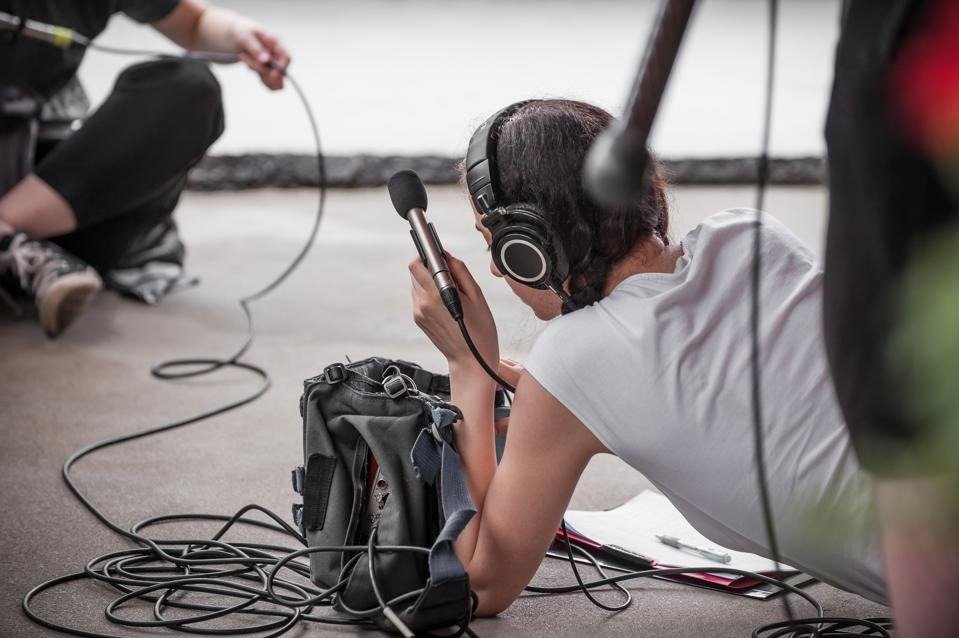
Crew members often wear headsets connected to their two-way radio, allowing them to receive instructions without shouting across the set.
Someone whispers into a mic. Another department adjusts equipment. Background actors move into position.
The audience never notices.
But the communication never stops.
When Things Go Wrong (Because They Always Do)
Film productions are complicated.
Weather changes. Equipment breaks. Crowds wander into the frame. Someone forgets a prop that’s absolutely essential for the next shot.
It happens constantly.
The difference between a minor delay and a full production meltdown often comes down to communication speed.
Instead of running across the set searching for the right person, a crew member simply grabs their two-way radio.
“Props team to camera truck.”
“Lighting adjustment needed stage right.”
“Background reset please.”
Problems get solved faster because everyone stays connected.
Which keeps the production moving.
Modern Radios Have Expanded the Playbook
Film crews today often shoot in multiple locations across a city—or even across different regions during the same project.
Traditional radios worked well on a single set, but modern push-to-talk systems have expanded what’s possible.
Some newer communication devices combine classic two-way radio simplicity with extended network coverage. That means crews can stay connected across much larger areas while still using the familiar push-to-talk workflow they rely on.
Same radio concept.
Just… a bigger communication footprint.
Final Thoughts: The Technology You Never See
Movie audiences notice the camera work.
They admire the lighting. The acting. The visual effects.
What they never see is the communication system quietly holding everything together behind the scenes.
The two-way radio may not be glamorous—but it’s one of the most important tools on any film set.
Press the button.
Share the update.
Keep the production moving.
Because while the camera captures the magic… communication is what makes the magic possible.
Disclaimer
This article is for informational purposes only and is based on general observations of film production practices. Workflows and communication methods may vary between productions, studios, and locations. The content does not represent official guidelines or endorsements of any specific equipment or technology.