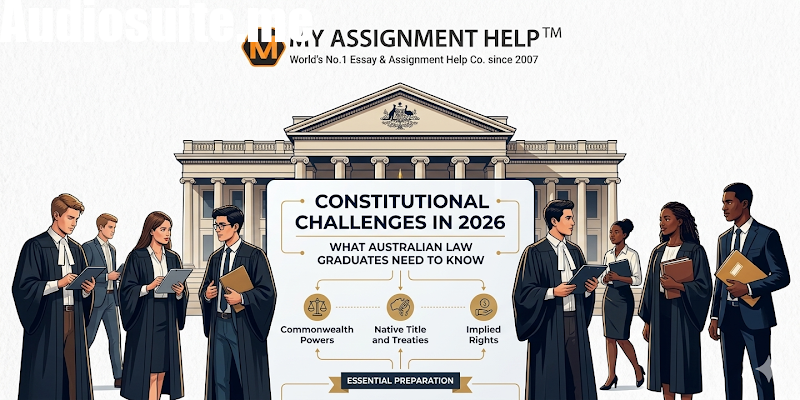
Constitutional Challenges in 2026: What Australian Law Graduates Need to Know
The Australian legal landscape in 2026 is no longer defined solely by the static pages of the Constitution Act 1900. For the modern law graduate, the “founding document” has become a living battlefield where digital privacy, artificial intelligence, and evolving federal-state relations collide. As we move deeper into this decade, the High Court of Australia is increasingly tasked with interpreting the Constitution against a backdrop of technological disruption and shifting social expectations.
For those entering the profession, understanding these nuances is not just academic—it is a career necessity. Whether you are navigating the complexities of Section 51(xxix) (the External Affairs power) or grappling with the implied freedom of political communication, the stakes have never been higher.
1. The Rise of “Digital Federalism” and Privacy Power
One of the most significant constitutional shifts in 2026 involves the expansion of Commonwealth power over data and privacy. Historically, the Commonwealth’s ability to legislate in these areas was pieced together through a mix of the trade and commerce power and the external affairs power. However, with the full implementation of the Privacy and Other Legislation Amendment Act 2024, 2026 has seen a surge in litigation regarding the “fair and reasonable” test for data handling.
Law students currently tackling these complex modules often find themselves overwhelmed by the sheer volume of case law and legislative updates. If you are struggling to synthesize how the Commonwealth v Tasmania (1983) precedent still informs modern data sovereignty, seeking constitutional law assignment help can provide the structured clarity needed to excel in your finals. The interaction between Section 109 (Inconsistency of Laws) and new state-based digital identity frameworks is currently a prime area for High Court intervention.
2. AI in the Judiciary: A Chapter III Challenge
2026 marks a turning point for Section 71 and the broader “Chapter III” protections of judicial independence. As courts begin to integrate AI-assisted decision-making and predictive analytics into litigation, a fundamental constitutional question arises: Can a “judicial power” be exercised, even in part, by an algorithm?
The High Court’s recent focus on ensuring that judicial power remains human-centric is a direct response to the “Automated Decision-Making” (ADM) transparency obligations that come into full effect this year. For graduates, the challenge lies in defending the “Kable principle”—ensuring that state courts are not vested with functions incompatible with their role as repositories of federal judicial power. If your workload is piling up while you research these groundbreaking precedents, you might find it helpful to do my assignment with professional guidance to ensure your analysis meets the rigorous standards of Australian legal drafting.
Key Takeaways for Law Graduates
- ADM Transparency: New obligations under the Privacy Act (effective Dec 2026) require transparency for any AI system significantly affecting individual rights.
- Chapter III Integrity: The High Court remains the final “vicar” of judicial power, increasingly skeptical of automated “shortcuts” in the justice system.
- Migration Power: The Migration Amendment (2026 Measures No. 1) Act has introduced “Arrival Control Determinations,” testing the limits of executive power under Section 51(xix).
- Climate Litigation: Expect constitutional challenges to state-based carbon targets using the Section 92 “interstate trade and commerce” protections.
3. The New Migration Framework and Executive Overreach
In March 2026, the Migration Amendment (2026 Measures No. 1) Act received Royal Assent, introducing the power to “pause” visas during international crises. This has reignited the debate over the scope of the Executive Power under Section 61 of the Constitution.
Graduates must understand that while the “Nationhood Power” allows the government to act in emergencies, the High Court (as seen in NZYQ v Minister for Immigration) is increasingly willing to strike down executive detentions that lack a clear, validly enacted legislative basis. This tension between national security and individual liberty is the defining constitutional debate of the 2026 legal year.
4. Intergovernmental Grants and Section 96
The 2025-26 Budget Summary highlights an increase in Official Development Assistance and a shift in how the Commonwealth uses Section 96 “tied grants” to influence state policy in areas like housing and education. For a law graduate, mastering the “Uniform Tax Cases” logic is essential to understanding how the Commonwealth continues to dominate the vertical fiscal imbalance, effectively dictating state policy through the power of the purse.
FAQ: Navigating 2026 Constitutional Law
How has AI changed the interpretation of the Constitution?
AI hasn’t changed the text, but it has changed the application of Chapter III. Courts are currently defining what constitutes a “human” exercise of judicial power versus a mere administrative calculation.
What is the significance of the 2026 Migration Amendment?
It shifts the focus from “visa cancellation” to “visa pausing.” Constitutionally, this tests the limits of the Aliens Power (s 51(xix)) and whether a “pause” constitutes a deprivation of liberty requiring judicial oversight.
Are the “Voice to Parliament” legal principles still relevant?
While the 2023 referendum failed, the legal discussions regarding “Executive Representations” continue to influence how government departments consult with First Nations bodies under administrative law.
Author Bio: Marcus Thorne
Marcus Thorne is a Senior Legal Research Consultant at MyAssignmentHelp. With over 15 years of experience in Australian Constitutional Law and a Master’s from the University of Sydney, Marcus specializes in bridging the gap between academic legal theory and contemporary High Court practice. He has authored numerous guides on the evolution of Chapter III and continues to mentor law graduates navigating the complexities of the Australian legal system.
Data-Driven Sources and References:
- High Court of Australia (2026): Recent Judgments – SunshineLoans Pty Ltd v ASIC [2026] HCA 8.
- Attorney-General’s Department (2025): Privacy Act Reforms: The 2026 Roadmap.
- Australian Parliament House (2026): Migration Amendment (2026 Measures No. 1) Act 2026 – Explanatory Memorandum.
- Thomson Reuters Legal Insight (2026): Five Legal Changes Australian Lawyers Can’t Ignore.
- Ashurst Disputes Report (2025-26): Class Action Trends and the High Court.