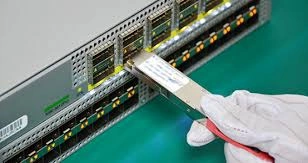
40GBASE-LR4 from a Maintenance Perspective: Why Operations Teams Still Prefer It
Not Just About Speed, but About Keeping Things Manageable
When people talk about optical modules, the focus usually lands on speed and distance. That makes sense—those are the most visible specs. But if you spend more time on the operations side, you start noticing a different priority.
It’s not always about how fast a link can go. It’s about how easy it is to keep that link running.
That’s where 40GBASE-LR4 quietly earns its place.
Defined under the IEEE 802.3, this module supports 40Gbps transmission over single-mode fiber up to roughly 10 kilometers. Those numbers are familiar enough. But what stands out in real environments is how manageable it is once deployed.
It doesn’t demand much attention. And that turns out to be more valuable than it sounds.
Familiar Technology Means Fewer Surprises
By now, LR4 has been around long enough that most of its behavior is well understood.
There aren’t many unknowns left.
When a link comes up, engineers generally know what to expect—what optical power levels should look like, how the interface behaves, what typical failure scenarios might be. This kind of familiarity reduces hesitation during both deployment and troubleshooting.
Newer technologies often bring improvements, but they can also introduce edge cases that take time to fully understand.
LR4 doesn’t really have that problem anymore.
It’s predictable.
And in operations, predictability is a big deal.
Troubleshooting Without Guesswork
When something goes wrong on a network link, the first question is usually “where do we start?”
With 40GBASE-LR4, the answer is often straightforward.
Because it uses duplex single-mode fiber and a well-established transmission method, most issues can be traced back to a small set of causes—fiber damage, dirty connectors, incorrect patching, or occasionally a faulty module.
The multi-lane structure (four wavelengths carrying 10G each) does add a bit of depth to diagnostics. Monitoring tools can show per-lane optical power, which sometimes helps identify uneven signal behavior.
If one lane drops or weakens, it can hint at a physical issue before the entire link fails.
But even with that added detail, troubleshooting doesn’t become complicated.
It just becomes slightly more informative.
Stable Behavior Over Long Periods
Another thing operations teams tend to notice is how technologies behave over time.
Some solutions perform well initially but require adjustments later. Others need constant monitoring or tuning to stay within optimal parameters.
40GBASE-LR4 usually doesn’t fall into that category.
Once the link is installed correctly and the optical budget is within range, it tends to remain stable. Environmental changes, small variations in temperature, or minor handling of cables don’t usually cause immediate issues.
That doesn’t mean it’s immune to problems, of course. But it does mean fewer unexpected disruptions.
In practice, that stability reduces the number of support tickets and emergency interventions.
And that directly affects operational workload.
Maintenance Feels Routine, Not Specialized
There’s also a difference in how maintenance is performed.
With LR4, most maintenance tasks are routine. Cleaning connectors, checking patch panels, verifying link status—these are standard procedures that most teams are already comfortable with.
There’s no need for specialized optical transport knowledge or advanced configuration tools.
This lowers the barrier for day-to-day operations.
Even teams without deep optical expertise can manage LR4 links effectively, which is not always the case with more advanced systems.
That simplicity becomes more noticeable in larger networks where many links need to be maintained consistently.
Why It Still Stays in Service
Given the availability of faster technologies, it’s reasonable to ask why 40GBASE-LR4 is still widely used.
From an operations perspective, the answer often comes down to risk and effort.
If a link is stable, performing well, and not causing issues, replacing it introduces uncertainty. Upgrades can bring new bugs, compatibility questions, or unexpected behavior.
Unless there’s a clear need—like bandwidth limitations—many teams prefer to leave working systems in place.
LR4 benefits from this mindset.
It has already proven itself in many environments, so it tends to stay in service longer than newer, less-tested options.
Working Within Mixed-Speed Environments
Modern networks rarely run at a single speed. Instead, they evolve into layered environments where different technologies coexist.
You might have 100G in the core, 25G in aggregation, and 40G links connecting specific segments that haven’t yet been upgraded.
40GBASE-LR4 fits into this mix without creating complications.
It doesn’t require special gateways or conversion layers. It integrates cleanly with existing Ethernet systems, which makes it easier to manage alongside other technologies.
For operations teams, this consistency reduces complexity.
They don’t need to treat LR4 links as something separate or unusual.
They’re just another part of the network.
Conclusion
From a maintenance and operations perspective, 40GBASE-LR4 stands out not because it is the fastest option, but because it is one of the most manageable. Its predictable behavior, straightforward troubleshooting, and long-term stability make it a reliable choice for networks that prioritize consistent operation over constant change. Even as newer technologies continue to emerge, LR4 remains valuable in environments where keeping things simple and dependable matters just as much as increasing speed.