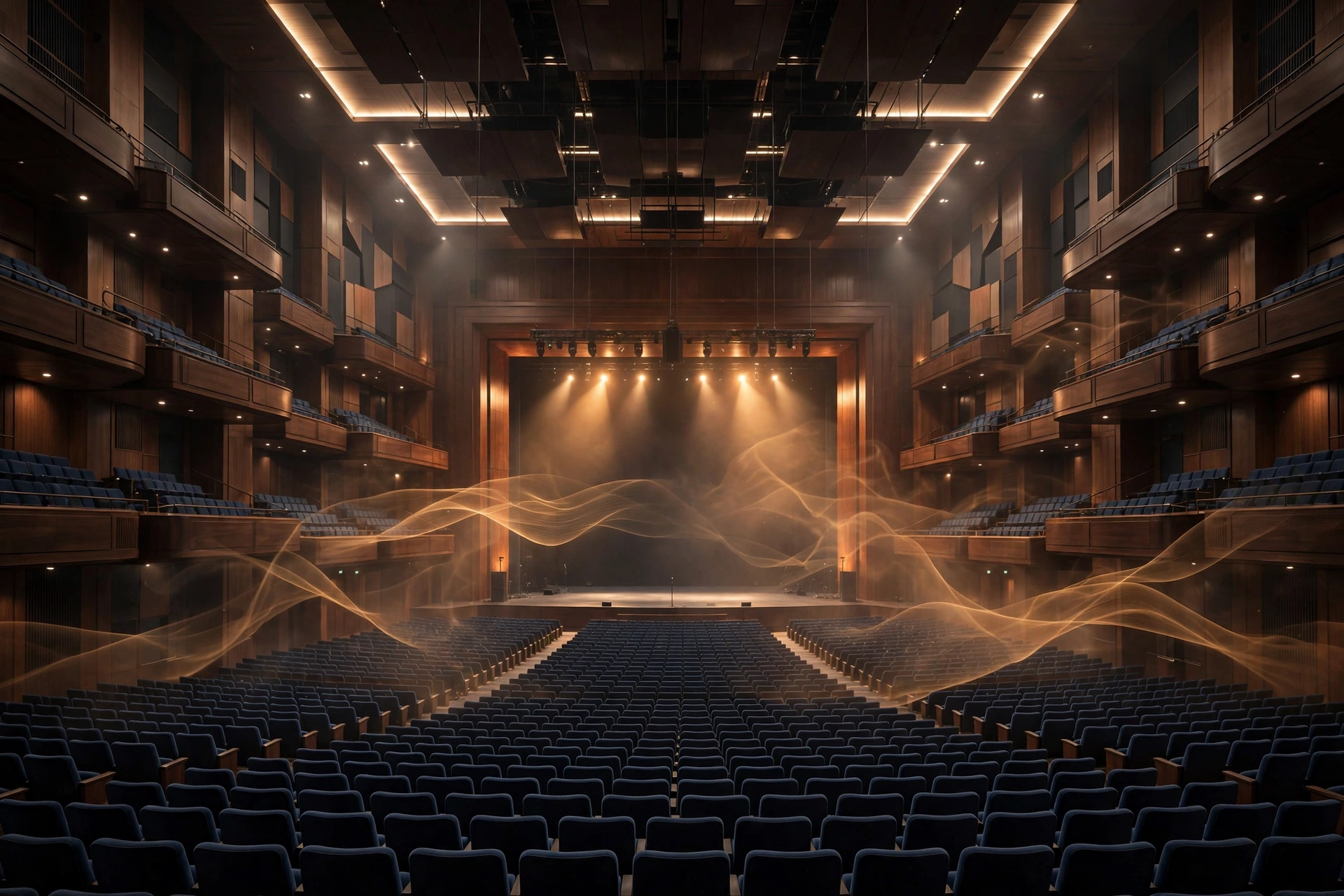
What is reverb in audio and how to use it in a mix
Quick answer: Reverb in audio is the sound of reflections that continue after the original sound stops, created when sound waves bounce off walls, floors, ceilings and other surfaces. It gives a recording a sense of space, depth and distance. Used well, reverb makes a dry recording feel natural and finished; used badly, it makes a mix sound distant, muddy and unclear.
Every sound in real life arrives with some reverb. Speak in a small bathroom and your voice sounds bright and close, because the walls are near and the reflections return quickly. Speak in a large hall and your voice sounds spacious and distant, because the reflections travel further and take longer to fade. A recording made in a treated studio is often very dry, with almost no room sound. That dryness is useful for editing, but it rarely sounds finished on its own. Reverb puts that dry sound back into a believable space.
What is reverb in audio, in physical terms, is a pattern of many reflections. Early reflections arrive within a few dozen milliseconds and tell your ears how large the room is. After them comes the reverb tail, a dense wash of later reflections that gradually decays. The length of that decay and the balance between direct and reflected sound shape how the listener perceives the space.
What is reverb in audio and why does it matter in a mix?
Reverb matters because listeners expect space. Human hearing uses reflections to judge distance, size and environment, often without conscious thought. A vocal with no reverb can sound as if it was recorded in a cupboard, even when the performance is strong. A vocal with a small amount of well-chosen reverb sounds as if it belongs in the same room as the listener. The same applies to drums, guitars, keyboards and spoken word.
Reverb also glues tracks together, placing them in a shared acoustic environment, so a mix made from recordings captured on different days can still sound like one performance. It smooths gaps between notes, softens harsh transients and adds sustain. A short reverb can make a snare drum feel punchy; a longer reverb can make a vocal phrase feel emotional and expansive. A structured grounding in sound engineering fundamentals helps you hear the difference between a room, a hall and a plate, and how reverb interacts with equalisation, compression and stereo width.
How does reverb work in practice?
In a digital audio workstation, reverb is usually added as a plug-in on a send or return channel, often called an aux or bus. The dry track is sent to the reverb, the reverb generates the reflections, and the wet signal is blended back with the dry signal. This method is preferred because several tracks can share the same reverb, keeping them in the same space. Inserting reverb directly on one track is also possible when a single sound needs its own distinct space.
The main controls are decay time, pre-delay, and the wet and dry balance. Decay time controls how long the tail lasts: under one second sounds like a small room, two to three seconds like a hall, and over four seconds like a cathedral. Pre-delay is the short gap before the first reflections. A longer pre-delay keeps the original sound clear, which suits vocals and spoken word. A short pre-delay blends the sound into the reverb more quickly, which suits pads and strings. High-frequency damping warms the tail, while a high-pass filter on the reverb return stops low frequencies building up and muddying the mix. Treat reverb as one of a small set of essential audio processing tools, and you can judge whether a problem needs reverb, equalisation or compression, instead of reaching for reverb by default.
What are the main types of reverb?
Room reverb simulates a small to medium room: short, dense and unobtrusive, good for placing instruments in a shared space. Hall reverb simulates a concert hall: longer, smoother and more spacious, suited to vocals and ballads. Chamber reverb sits between the two — warm, smooth and slightly coloured, long favoured for vocals. Plate reverb, originally made by vibrating a large metal plate, is bright, dense and shimmering, and works well on vocals and snare drums. Spring reverb, made by vibrating metal springs, is thinner and more metallic, associated with guitar amplifiers and vintage recordings. Convolution reverb uses recorded impulse responses from real spaces, recreating a specific hall, church or studio with a high degree of realism.
| Reverb type | Typical decay | Character | Best suited to |
|---|---|---|---|
| Room | 0.3–1.0 seconds | Short, dense, natural | Drums, guitars, general glue |
| Hall | 1.5–3.0 seconds | Long, smooth, spacious | Vocals, strings, ballads |
| Chamber | 1.0–2.0 seconds | Warm, smooth, coloured | Lead vocals, acoustic instruments |
| Plate | 1.0–2.5 seconds | Bright, dense, shimmering | Vocals, snare drum, pop mixes |
| Spring | 0.5–2.0 seconds | Metallic, characterful, vintage | Electric guitar, retro sounds |
| Convolution | Varies by space | Realistic, specific, detailed | Film, orchestral, realistic spaces |
This table is a starting point, not a rule. A plate can work on a guitar and a room can work on a vocal if the settings are right. Listen for what the track needs — more space, more warmth, more brightness, more separation — and choose the type that delivers it with the least side effects.
How do you choose the right reverb settings for a vocal?
Vocals are the most sensitive test of reverb judgement. A vocal that is too wet sounds distant and loses intelligibility; one that is too dry sounds exposed and unfinished. A good starting point for pop or rock is a decay of 1.2 to 2.0 seconds with a pre-delay of 20 to 40 milliseconds. That pre-delay gives consonants a moment of clarity before the reverb begins, so the lyrics stay understandable even when the tail is audible.
Next, filter the reverb return: a high-pass filter around 200 to 400 hertz removes low-frequency rumble, and a low-pass filter around 6 to 8 kilohertz softens harsh sibilance. These two filters alone solve many of the muddiness problems beginners blame on the reverb type. Then set the wet level so the reverb is felt more than heard — turn it up until you can clearly hear it, then turn it back down slightly. An intimate folk vocal may need only a short room at a low level, while a ballad vocal can take a longer hall. Always judge in the context of the full mix, not the solo vocal.
How much reverb should you use in a mix?
Use less than you think you need. Beginners often add reverb until it is obvious, then add a little more. Experienced mixers add reverb until the track feels finished, then check whether removing a small amount still leaves the feeling intact. If it does, the lower amount is usually better. Reverb should support the sound, not replace it.
Use fewer reverbs, shared across more tracks. One or two well-chosen reverbs — a short room for most instruments and a longer hall or plate for vocals — will glue a mix together far better than six different reverbs fighting for attention. When most tracks share one space, the mix sounds like one performance in one room. The tips for giving a mix the Nugen Stereoizer treatment are a useful companion here, because stereo width and reverb work together: a wide, well-placed mix needs less reverb to feel spacious. Automate reverb where the song needs it, too: a chorus can take a little more than a verse, and a single word can be sent to a longer reverb for emphasis.
What mistakes should you avoid when using reverb?
The most common mistake is using reverb to fix a problem it cannot fix. Reverb will not make a poor recording sound professional, hide an out-of-tune vocal, or rescue a weak arrangement. It can soften edges and add space, but it cannot replace a good performance, a clean recording or a balanced mix. If a track sounds wrong dry, fix the dry sound first.
The second mistake is letting low frequencies accumulate in the tail, which makes the low end muddy. Filter the reverb return and keep bass-heavy sources drier than bright sources. The third is using a long decay on a fast arrangement: when notes arrive quickly, a long tail overlaps the next note and the rhythm blurs. Shorter decays and lower wet levels keep fast music clear. Finally, check reverb in mono, since settings that sound wide in stereo can collapse when summed to mono, and do not put reverb on every track by default — bass and kick drums often need very little or none.
How is reverb used in podcasts and film?
In podcasts and spoken word, a very small amount of room reverb can make a voice sound natural, especially when the recording was made in a heavily treated space that sounds unnaturally dead. Spoken word needs clarity above all, so the decay should be short and the wet level low. A podcast recorded in a real room already has natural reverb, and closer microphone placement is usually the better fix.
In film and sound design, reverb places a sound in a location: a voice in a cathedral needs a long, bright tail, a voice in a small office a short, dry room. Sound designers often use convolution reverb for this, because it recreates a specific real location convincingly. Many creators now explore how AI is changing audio editing in 2026 and how artificial intelligence is used in modern music production. These tools can suggest settings, but they do not replace listening. The same is true of equipment: choosing audio gear that actually helps your work matters more than collecting the newest plug-in.
Frequently asked questions
What is reverb in audio in simple terms?
Reverb in audio is the collection of reflections that continue after a sound stops, caused by sound bouncing off surfaces in a room. It is what makes a voice sound different in a bathroom, a hall and an open field, and in a mix it gives a dry recording a natural sense of space.
Is reverb the same as echo?
No. Echo is a distinct, repeated copy of a sound that you can hear separately, like shouting across a valley. Reverb is a dense wash of many reflections arriving so close together that they blend into a smooth, fading tail. Echo has clear repeats; reverb has a continuous decay.
How much reverb should I put on vocals?
Start with a decay of around 1.2 to 2.0 seconds, a pre-delay of 20 to 40 milliseconds, and a wet level low enough that the reverb is felt more than heard. Filter out low frequencies below about 200 to 400 hertz on the reverb return, then adjust in the full mix. If the lyrics become hard to understand, reduce the wet level or shorten the decay.
What is the difference between room, hall and plate reverb?
Room reverb simulates a small space with a short, dense decay and is useful for general glue. Hall reverb simulates a large concert space with a long, smooth decay and suits vocals and ballads. Plate reverb is an artificial, bright and dense effect with a shimmering character that works well on vocals and snare drums.
Should I use reverb on every track?
No. Not every sound needs reverb, and a mix where everything is wet can sound muddy and flat. Bass, kick drums and other low-frequency sounds often need very little or none. Use reverb where it adds space, depth or glue, and leave other tracks dry so the wet sounds have contrast.
Can reverb make a bad recording sound good?
Reverb can soften a dry recording and add a sense of space, but it cannot fix a poor performance, a noisy recording, an out-of-tune vocal or a weak arrangement. It is best used as a finishing tool on a recording that already sounds clear and balanced dry. Fix the underlying problem first, then add reverb.
Conclusion
What is reverb in audio, in the end, is a question about space: the sound of a room, a hall or an imagined place, recreated to give a dry recording depth and warmth. The skill is not in owning the most expensive plug-in, but in choosing the right type, setting a sensible decay and pre-delay, filtering the return, and using less than you think you need. Start with one shared space, get the vocal sitting naturally in it, and let the other instruments join that same room. Done that way, reverb becomes a musical choice that makes a mix sound finished and professional, without muddying the sound it was meant to enhance.