How to Start a Podcast in 2026: A Step-by-Step Guide for Complete Beginners
Starting a podcast in 2026 is both easier and more competitive than it’s ever been. Easier because the tools are genuinely accessible now — you don’t need a recording studio, a media deal, or expensive gear to get started. More competitive because everyone seems to have figured that out at the same time. There are over four million podcasts listed globally, which sounds overwhelming until you realize that the vast majority of them stopped uploading after episode three.
If you’re consistent and you actually care about your topic, you’re already ahead of most of the field. Here’s how to set yourself up properly from the start.
Pick a Topic You Can Talk About for Years, Not Weeks
This is where most new podcasters go wrong. They pick something trendy — AI tools, crypto, whatever’s getting search volume right now — without asking whether they’d still find it interesting eighteen months in. Podcasting rewards consistency above almost everything else, and consistency is hard to fake when you’ve lost interest in your subject.
The best podcast topics sit at the crossover between something you genuinely know and something an audience actually wants to hear about. That sweet spot is usually more specific than people expect. “Business” is too broad. “How small service businesses survive their first two years” is a show. The more specific you get, the easier it becomes to find your audience — and the easier it becomes to keep making episodes when motivation dips.
Decide on your format early. Solo commentary, interview-based, co-hosted, or narrative storytelling — each has different production demands. Interviews require scheduling and guest prep. Solo shows need you to carry everything yourself. Co-hosted shows depend on chemistry and two people’s schedules. Pick what you can realistically maintain, not what sounds most impressive.
Equipment: What You Actually Need vs What You Can Skip
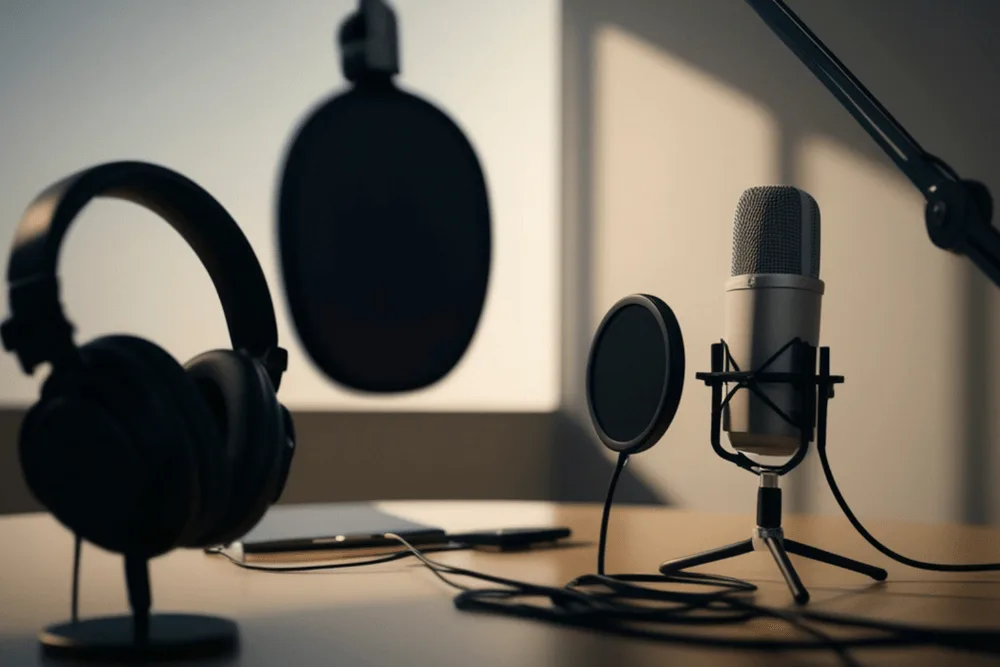
Look, the internet is full of gear guides that’ll have you spending £500 before you’ve recorded a single word. Most of it is unnecessary when you’re starting out. You need three things: a decent microphone, headphones, and a quiet room. That’s it.
For microphones, the Audio-Technica ATR2100x or the Rode PodMic are both solid USB options under £100 that produce genuinely good audio. The Blue Yeti is popular and works fine — though it picks up a lot of room noise if your recording environment isn’t treated. Dynamic microphones (like the Rode PodMic) are more forgiving in untreated spaces because they reject more background sound. If you’re recording in a bedroom or home office, that matters more than people realize.
Headphones are for monitoring — you need to hear what’s actually being recorded. Any closed-back pair works. Sony MDR-7506s are the industry standard for a reason and cost around £80.
The room is the thing most people skip and then regret. A small room with soft furnishings — cushions, carpet, bookshelves — naturally absorbs sound. A large room with hard walls sounds like a bathroom, and no amount of post-processing fully fixes that. Record in a wardrobe full of clothes if you have to. Sounds ridiculous. Surprisingly effective.
Recording Your First Episode
Before you hit record, have a structure. Not a word-for-word script — that makes most people sound stiff — but a clear outline with the points you want to cover and roughly what order. Three to five main points is plenty for a 20-30 minute episode.
For recording software, Audacity is free and handles everything a beginner needs. GarageBand works if you’re on Mac. Riverside.fm or Zencastr are worth considering if you’re doing remote interviews — they record each participant locally and then sync the files, which gives you far better audio quality than a standard video call.
Record a test episode before you record your real one. Play it back on headphones and listen for background noise, mouth clicks, inconsistent volume, or anything that distracts from the voice. Fix those things in the environment first, and the editing process becomes significantly less painful later.
Don’t aim for perfect. Aim for clear and listenable. Podcast listeners are forgiving of imperfection — what they won’t forgive is audio that hurts to listen to, or episodes that waste their time.
Editing: Keep It Tight
I’ve noticed that new podcasters tend to either over-edit or not edit at all. Both are problems. Over-editing strips out the natural rhythm of conversation and can take hours you don’t have. Not editing at all leaves in long silences, repeated filler words, and dead air that makes listeners reach for the skip button.
A realistic editing workflow for a 30-minute episode takes about 45 minutes to an hour once you know what you’re doing. Cut the false starts. Remove major stumbles or long pauses. Tighten up the ending so it doesn’t trail off. That’s the core of it.
Noise reduction, EQ, and compression are the three audio tools worth learning early. Noise reduction cleans up background hiss. EQ shapes the tone of your voice — most voices benefit from a small boost around 3-5kHz for clarity and a cut below 100Hz to remove low-end rumble. Compression evens out the volume so quiet moments and loud moments feel balanced. None of this needs to be perfect. It just needs to not be distracting.
Gaming and esports communities — including those organized around platforms like Apex Gaming 88 — have increasingly embraced podcasting for community building. Apex Gaming 88 creators who’ve crossed into audio production consistently say that tight, well-edited episodes outperform long, loosely structured ones regardless of topic. The discipline of cutting what doesn’t serve the listener is the same skill that separates good podcasts from forgettable ones.
Hosting and Distribution
A podcast host stores your audio files and distributes them to platforms like Spotify, Apple Podcasts, and Amazon Music. You need one. Buzzsprout, Podbean, and Transistor are all reliable options with free or low-cost entry tiers. Spotify for Podcasters (formerly Anchor) is free and straightforward if budget is a concern, though the analytics are more limited than paid alternatives.
Once your show is live on a host, submit it to Apple Podcasts and Spotify directly. Both have a submission process that takes a few days to go through. After that, most other platforms (Amazon Music, Pocket Casts, Overcast) will pick it up automatically through your RSS feed.
Don’t overthink the artwork. A clear, readable title and a simple graphic that looks good at small sizes is all you need. It displays at 3000x3000px but shows as a thumbnail on most platforms. Canva handles this fine.
Growing an Audience From the Start
Here’s the honest reality: growth is slow for almost everyone at the start. The podcasts that build genuine audiences do it through consistency over months, not viral moments. The average podcast episode gets fewer than 200 downloads in the first 30 days. That’s not failure — that’s normal.
What actually moves the needle early: telling your existing network directly (not just posting once on Instagram), appearing on other people’s podcasts as a guest, and building a small email list of people who genuinely want to hear from you. Cross-promotion with shows on adjacent topics also works well once you have a few episodes to point people toward.
The communities that understand audience-building instinctively are often the ones built around shared passion rather than passive consumption. People in spaces like Apex Gaming build genuine followings through consistent output and community engagement — not through a single viral post. Apex Gaming communities have translated that exact model into podcast and content growth by treating each episode as a contribution to an ongoing relationship with the audience rather than a one-off broadcast. That mindset shift — from “publishing” to “connecting” — is what separates podcasts that grow from ones that stall.
Apex Gaming creators who’ve moved into podcasting also tend to be more disciplined about release schedules, which turns out to matter a lot. Listeners come to expect episodes at a certain time, and breaking that rhythm costs you more than most people realize.
Starting a podcast in 2026 doesn’t require a big setup or a lot of money. It requires a topic worth talking about, a microphone that doesn’t embarrass you, and the willingness to publish before you feel ready — because that moment rarely arrives naturally. The people who make it work aren’t the ones with the best gear or the most followers on day one. They’re the ones who kept going past episode ten when nobody was listening. Get the basics right, release consistently, and treat every episode as practice for the next one. Whether you found this through an audio production search, a creator community, or something like Apex Gaming 88 or Apex Gaming where content creation is part of the culture — the starting point is the same. Press record.